
Hyper-Conscious Consumption
Why and How to Consume as if the Distributive State Already Exists

The proliferation of consumptive behavior over the past century has done great harm to the individual’s capacity for economic freedom. Impulsivity has triumphed over prudence, allowing the short-term to reign over the long-term. Society’s fortitude has decayed to the point where keeping up with the Joneses has distanced us so greatly from the idea of saving for a rainy day. Prioritizing self-serving emotional purchasing, no matter the conditions under which the product was produced, has caused us to turn away from seeking justice.
All the gluttony of today’s age gnaws at the little temperance that remains. In our increasingly consumptive condition, our virtues are continuously undermined through our transactions. Not only is our moral character compromised through mindless consumption, but our economic positions are greatly weakened.
In the absence of strong virtues and economic freedom, we find ourselves feeding like animals from a trough. Fattening ourselves on comforts and distraction as our muscles and brains wither, leaving us weak. A diet has become necessary for our current survival and future flourishing.
For quite some time now, “voting with your dollar” has been praised by those across the political spectrum. Too often, this phrase is mostly associated with partisan politics or never leaves the parking lot of a farmers’ market. At best, it pushes some folks to buy local, but most of the time, it is simply the shifting of consumption towards whichever company may be virtue signaling the best at the time. A more extreme phrase should be adopted that conveys the same message and then some. One that not only seeks to explicitly acknowledge how spending influences society, but also how it influences oneself.
Rather than vote with one’s dollar, one should command with it. Voters accept the possibility that they go unheard or that they may lose. Those who command have an implicit expectation that their standards be met, or they will go elsewhere. Commanding with your dollar is the aim of the hyper-conscious consumer. Through this proposed form of consumption, every purchase is evaluated on its moral, social, and economic consequences in relation to the consumer, their community, and their faith.
The hyper-conscious consumer is a consumer who has weaponized their behavior to direct production’s behavior, making it so that their capital is a governing force, rather than a democratic tool. Weaponization in this context should be interpreted as the disciplined and deliberate action of a knight, not the reckless aggression of a barbarian. Acting alone, the hyper-conscious consumer enriches themselves and their families through the cultivation of virtue required to command with one’s dollar. En masse, hyper-conscious demand is a force to be used by a society to bring about a more just world.
How does one weaponize their consumption? Ideally, the hyper-conscious consumer asks themselves a series of questions prior to purchasing anything. Is this necessary? How was this produced? Is it produced in accordance with the standards of the world I’d like to live in? By supporting this product, is my dignity upheld? Is the same true for my family and community? Does this work against or in support of my long-term economic freedom? Only by asking these questions can one’s virtue be applied to one’s consumptive behavior.
Rooted in the cardinal virtues, hyper-conscious consumption is the practice of exercising reasonable judgement upon spending. Temperance restrains the consumer from excessive consumption, guiding moderation that bolsters the spiritual, physical, and mental health of the consumer. Through prudence, needs and wants are clear. The consequences of today’s spending are weighed against the bright future ahead. Discernment of right and wrong regarding the production, distribution, marketing, or intention of a product ensures that justice is carried out by the consumer. While some are more reluctant to embrace hyper-conscious consumption than others, fortitude shields from peer pressure, endures through discomfort, and strengthens one’s ethical principles.
This proposed form of consumption stretches beyond concerns with morality, justice, and economics. It should also appreciate and incentivize beauty. Hyper-conscious consumption is not only about buying less but buying better. Craftsmanship, local culture, and tradition can be appreciated through consumption. The prioritized purchasing of beauty rewards the further pursuit of beauty.
Hyper-conscious consumers must command with their dollar to create the world in which they seek to live. The unstable system that we have inherited and continue to pass on has, for too long, allowed suppliers to manufacture and shape demand. It is time for the consumer to take on a more active role in guiding markets and shaping supply.
This is not a hopeless pursuit either. Our current economic system is fragile, and it could be argued that supply has become far more dependent on a passive consumer than the passive consumer is dependent on supply. Continuous expansion of consumer credit, consumer stimulus, and “safety nets” are policy avenues to ensure that the consumer continues their passive spending. The purpose of pointing this out is to highlight that the consumer in aggregate is a powerful force that has and can continue to mold policy and how business occurs.
Short-term degrowth is perhaps unavoidable in the case of a successful hyper-conscious consumer movement. However, if acted upon, it should see the return or strengthening of local communities, dignification of labor, and prioritization of family, which the current economic environment does not care for. Only if this changes can long-term growth be truly sustainable and secured. Growth outside of financial speculation is possible, and for markets that cannot yet be scaled down, they can be better governed by the population’s individual consumer choices.
The largest barrier to achieving hyper-conscious consumption is education. Without proper exposure to morality, ethics, faith, philosophy, and knowledge on general subjects, an individual lacks the resources needed to make their best decisions. Education’s improvement has several avenues, as it is not only through class and lessons, but through life. The local empowerment of the family, the churches, other social institutions, and schooling can aid the development of the hyper-conscious consumer. Increased transparency from businesses and governments can provide the individual with information needed to best exercise their judgement and develop trust among the population they serve.
Without the emergence of hyper-conscious consumers, there is no ability to bring about the Distributive State from where we currently stand. Individuals who consume without judgement are destined for dependence. Without incentives being created by the individual consumer, rather than only the government, the aims of concentrated capital will surely overrule our society’s hopes.
The exercise of judgement through virtue not only forces one’s surroundings to reckon with the individual and their community but also paves the road to widespread property ownership. Passive or degenerate consumption’s proliferation undermines the individual and family by pillaging incomes and preventing saving. By primarily spending according to one’s needs and thoughtfully acquiring wants, one’s overall outflow of wealth will likely reduce. As the wealth of the hyper-conscious consumer builds, the prospect of owning productive property in the future becomes increasingly tangible.
Should the Distributive State be one’s desire, hyper-conscious consumption is a necessary step that can be immediately acted upon by anyone. To assume that all will radically embrace the hyper-conscious consumer mentality overnight is naïve. But it should be recognized that if a significant portion of a regional population or broader population were to apply this hyper-conscious behavior to only a quarter of their areas of spend, they’d quickly begin to shape the areas in which their actions overlap.
Through guiding morals and virtues, our economies can be reorganized to uphold justice and beauty through individuals more deliberately consuming. The nature of economics has already vested consumers with the power to determine who continues operating and who will shut down. Only by exersizing that power and consuming as if the Distributive State is already among us can the Distributive State be achieved.
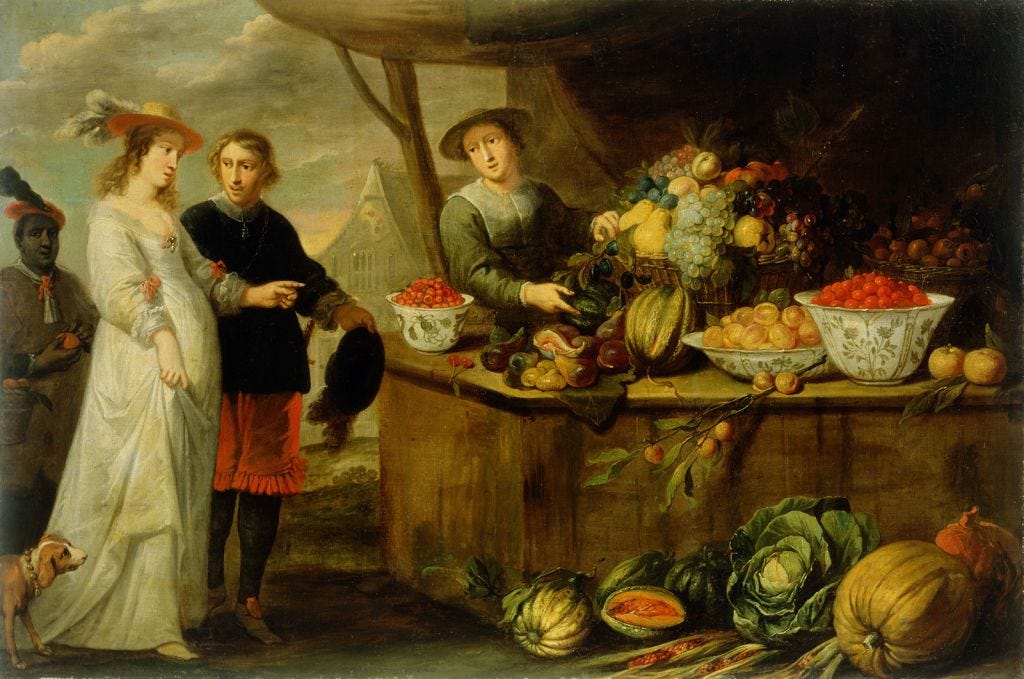
Anonymous, Noble Couple at the Market, 1650